


Fumio Nambata
Fumio Nambata
Biography
1941, April 27: Born in Tokyo as the second son of Tatsuoki Nambata (1905–1997) and Sumie Nambata.
He was named “Fumio” with the hope that he would grow up with books as his lifelong companions.
1949, 8 years old: Around this time, he painted self-portraits and other works using oil paints on sketch boards.
1957, 16 years old: Entered Waseda High School, where his father Tatsuoki also studied. During this time, he enjoyed music more than painting.
1960, 19 years old: Immersed in reading, he felt disillusioned with academics. After graduating from Waseda High School, he pursued his passion for art and entered the Art Department of Bunka Gakuin (Kanda Surugadai, Tokyo).
He showed little interest in classes such as plaster sketching, preferring instead to sketch and explore secondhand bookstores in Kanda on his own.
1962, 21 years old: Art critic Yoshiaki Higashino praised Fumio’s works and suggested he no longer needed to attend Bunka Gakuin.
He dropped out of the institution after two years and began focusing on independent production.
1963, 22 years old: Learned copperplate printmaking techniques from Masuo Ikeda at the print workshop of the Japan Artists’ Association.
1965, 24 years old: Enrolled in the Art Specialization Program at Waseda University’s School of Letters, First Division.
During this time, he rediscovered the joys of socializing.
1966, 25 years old: The intensifying university disputes caused him to experience emotional turmoil, leaving a lasting impact.
1970, 29 years old: Graduated from Waseda University’s School of Letters, First Division, majoring in Art.
1974, 32 years old: While returning from a trip to Kyushu, he disappeared after falling from the ferry “Harima” traveling from Kokura to Kobe on January 29.
On March 7, his body was discovered off the coast of Hakozaki, Mitoyo City, Kagawa Prefecture, by a fishing boat. (Aged 32)
1998: The Tatsuoki & Fumio Nambata Memorial Museum opened in Toyama City.
Main Exhibitions
1973: “Tatsuoki & Fumio Nambata Parent-Child Exhibition” (Asahikawa Gallery)
1971: “1st Newcomer Exhibition” (Mitsukoshi Nihonbashi); participated until the 4th exhibition.
1967: Held his first solo exhibition at Nanagallery (Shinbashi, Tokyo).
Posthumous Exhibitions
2024 50th Anniversary of Fumio Nambata’s Death: Youthful Meditations (Niigata Prefectural Museum of Modern Art)
2024 50th Anniversary Memorial Exhibition: Fumio Nambata (Toki-no-Wasuremono, Tokyo)
2024 Special Exhibition: 50th Anniversary of Fumio Nambata’s Death (Tokyo Opera City Art Gallery)
2021 Fumio Nambata: Lines and Colors (Tokyo Opera City Art Gallery)
2016 Youth of Artists — From Here, Painting Is Born + Special Feature “Color and Line: Fumio Nambata” (Niigata Bandaijima Art Museum)
2015 The World of Ryūki and Fumio Nambata (Waseda University Aizu Yaichi Memorial Museum)
2014 The World of Fumio Nambata: Adventures of the Imagination (Setagaya Art Museum)
2012 15 Years of Fumio Nambata (Tokyo Opera City Art Gallery)
2008 Fumio Nambata Exhibition (Setagaya Art Museum)
2004 30 Years After His Death — The Rushing Youth: Fumio Nambata (Tokyo Station Gallery)
1998 Preview 5: Fumio Nambata — Focusing on Unpublished Oil Paintings (Tokyo Opera City Art Gallery)
1981 Fumio Nambata: Poems of the Sea and the Sun — A Painter Who Died Young (Seibu Museum of Art)
1978 Ryūki, Norio, and Fumio Nambata (Ikeda Museum of 20th Century Art)
1976 Song of a Broken Youth: Fumio Nambata Memorial Exhibition (Odakyu Department Store Grand Gallery, Shinjuku)
1975 Fumio Nambata Memorial Exhibition (Fuji Television Gallery, Tokyo)
Public Collections
Tokyo Opera City Art Gallery
The National Museum of Modern Art, Tokyo
Niigata Prefectural Museum of Modern Art
Niigata Bandaijima Art Museum
Fukushima Prefectural Museum of Art
The Museum of Modern Art, Kamakura & Hayama
Tokushima Modern Art Museum
Kagami Modern Art Museum (Okayama)
Setagaya Art Museum (Tokyo)
Okawa Museum of Art (Gunma)
Fuchu Art Museum (Tokyo)
Ikeda 20th Century Museum (Shizuoka)
University of Tsukuba
Itabashi Art Museum
Shimonoseki City Art Museum (Yamaguchi)
Iwaki City Art Museum (Fukushima)
Jingu Art Museum (Mie)
Yokosuka Museum of Art (Kanagawa)
Utsunomiya Museum of Art (Tochigi)
Sakamoto Zenzo Museum of Art (Kumamoto)
Kiso Road Museum (Nagano)
Fujimi Civic Cultural Hall Kirari Fujimi (Saitama)
-
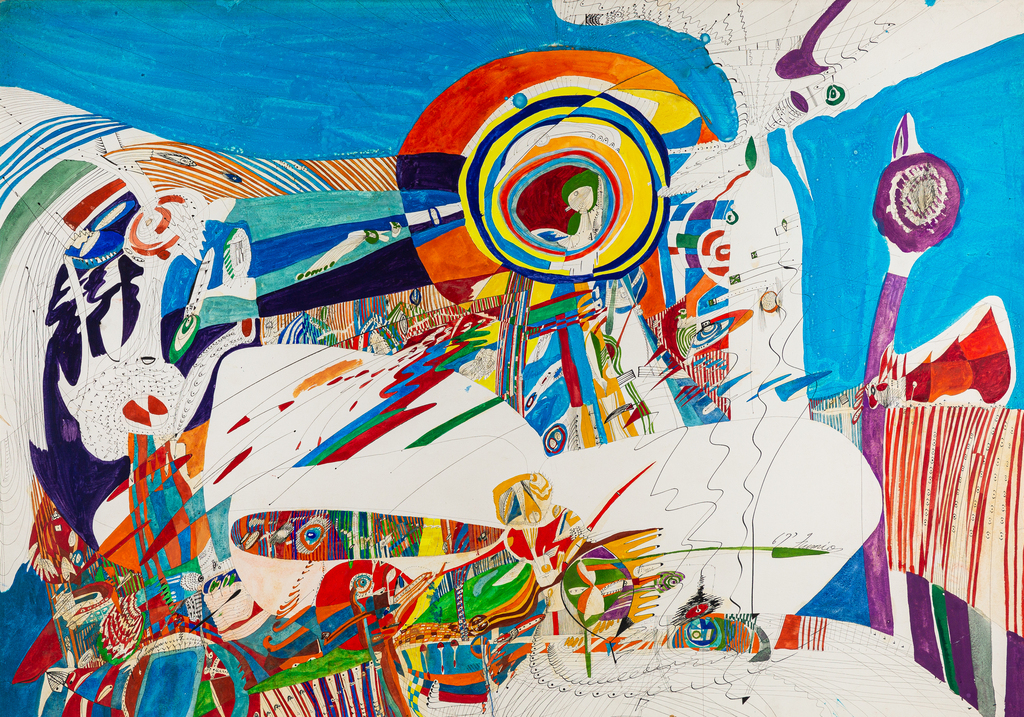
Hymn to the Sun
1967
-
Hymn to the Sun
1967